Most of Guanajuato tilts. The Jardín de la Unión does not. It is a small, level triangle in the bottom of the valley, roofed over with a single dense layer of clipped trees, and it is where the city comes to sit. People read the paper on iron benches, students meet before class, families wait for each other, and in the evening music drifts out from under the leaves. If the alleys are the city's veins, this is the place where they all seem to drain.
A triangle under clipped laurels
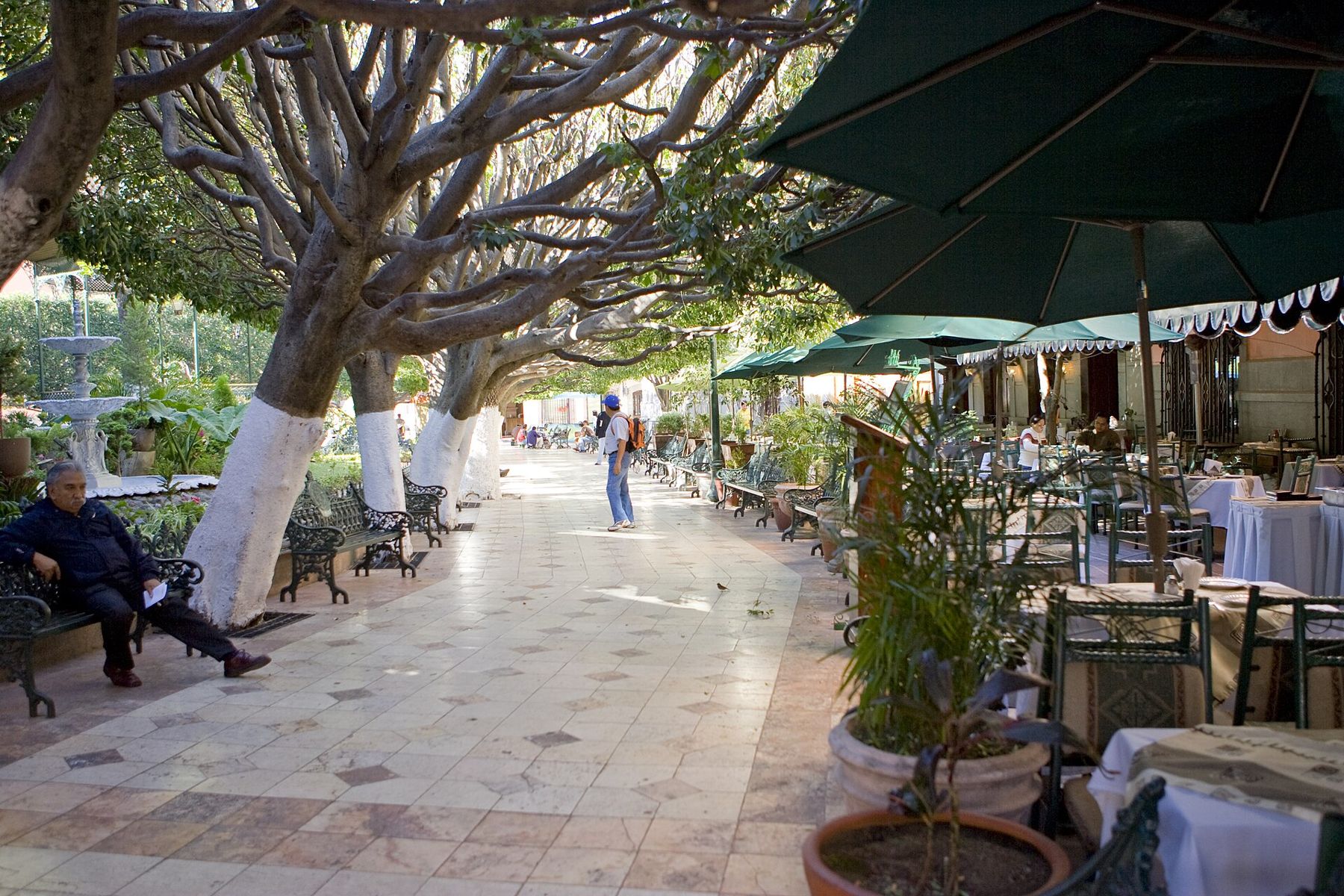
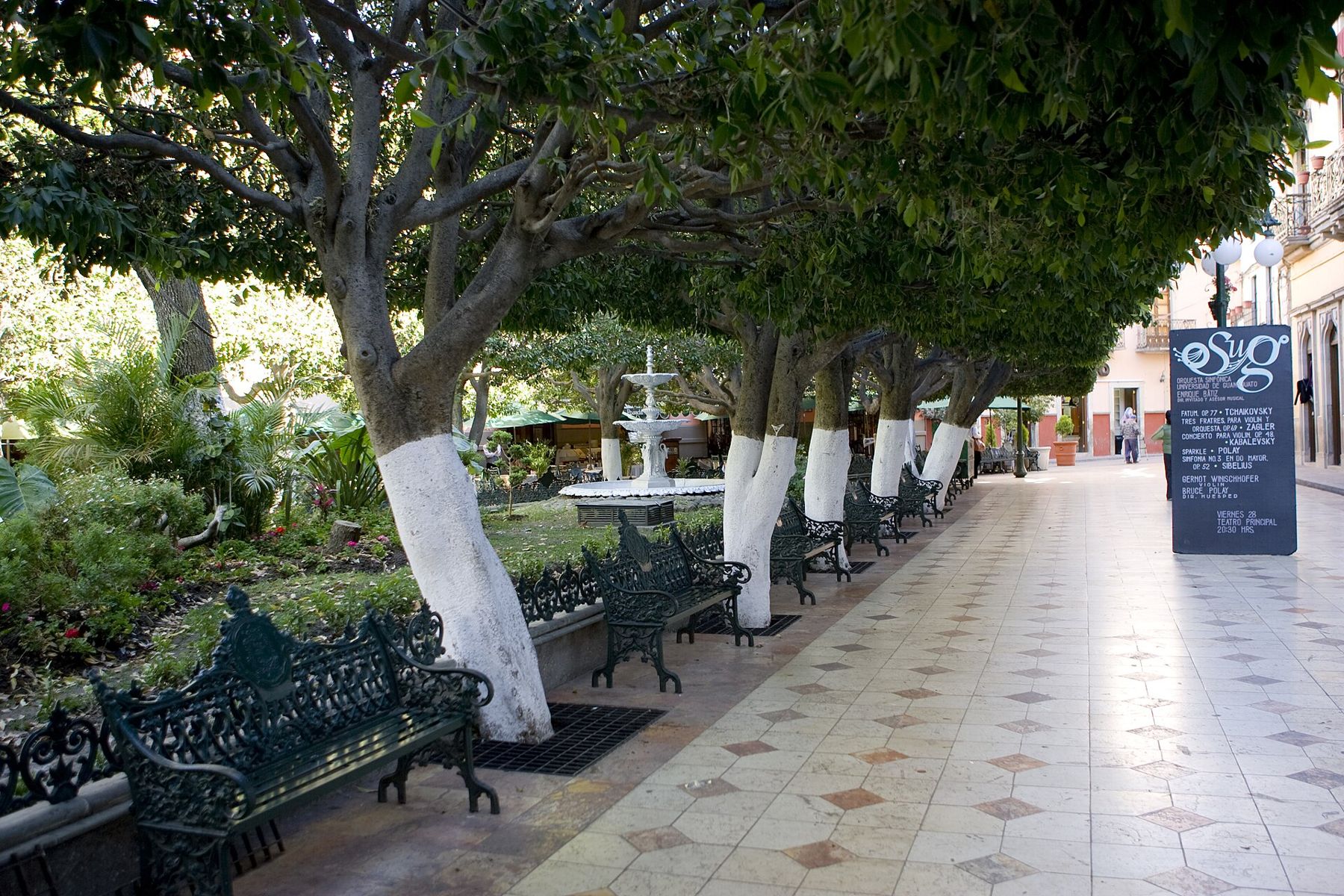
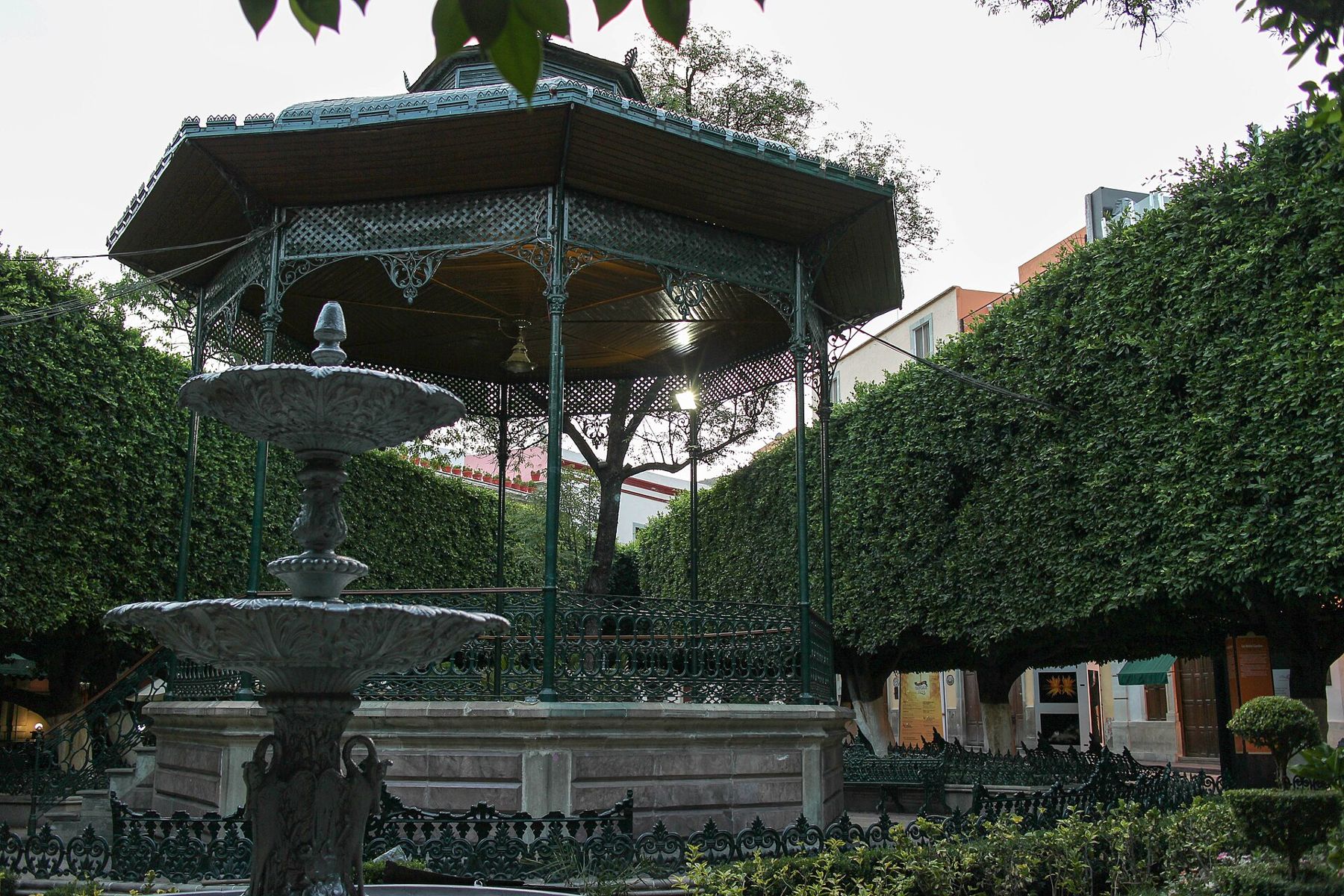
The plaza's shape comes from the streets around it, which meet at angles rather than in a square. Within that triangle, the ground is paved in pale stone with a pattern of darker diamonds, and the edges are lined with rows of Indian laurel trees, the laurel de la India. Their trunks are painted white at the base, and their crowns have been trimmed so closely and for so long that they form a flat green ceiling over the paths, thick enough to keep out the midday sun.
Under that ceiling everything is green shade and filtered light. Ornate iron benches, painted dark green, line the walks. In the middle stands an octagonal bandstand of iron lacework, the kiosco, and nearby a tiered fountain. Around the edges, café terraces spread their umbrellas under the trees. You will not be short of a seat.
Listen as well as look. Under the canopy, sound behaves differently: footsteps on the stone, the splash of the fountain, a guitar being tuned at a café table, the clatter of birds settling into the leaves at dusk. Pigeons and small birds work the paving for crumbs, and in the late afternoon the trees fill with noisy flocks coming in to roost. Keeping the canopy that flat and that dense takes patient, regular trimming, and the clean edges of the crowns are a quiet piece of the city's craft.
The plaza took its present form in the nineteenth century, on ground that had been the open space in front of the Franciscan convent of San Diego. Its name, the Garden of the Union, is a civic one, and it has held its place at the centre of the city's life ever since.
The Teatro Juárez and its steps
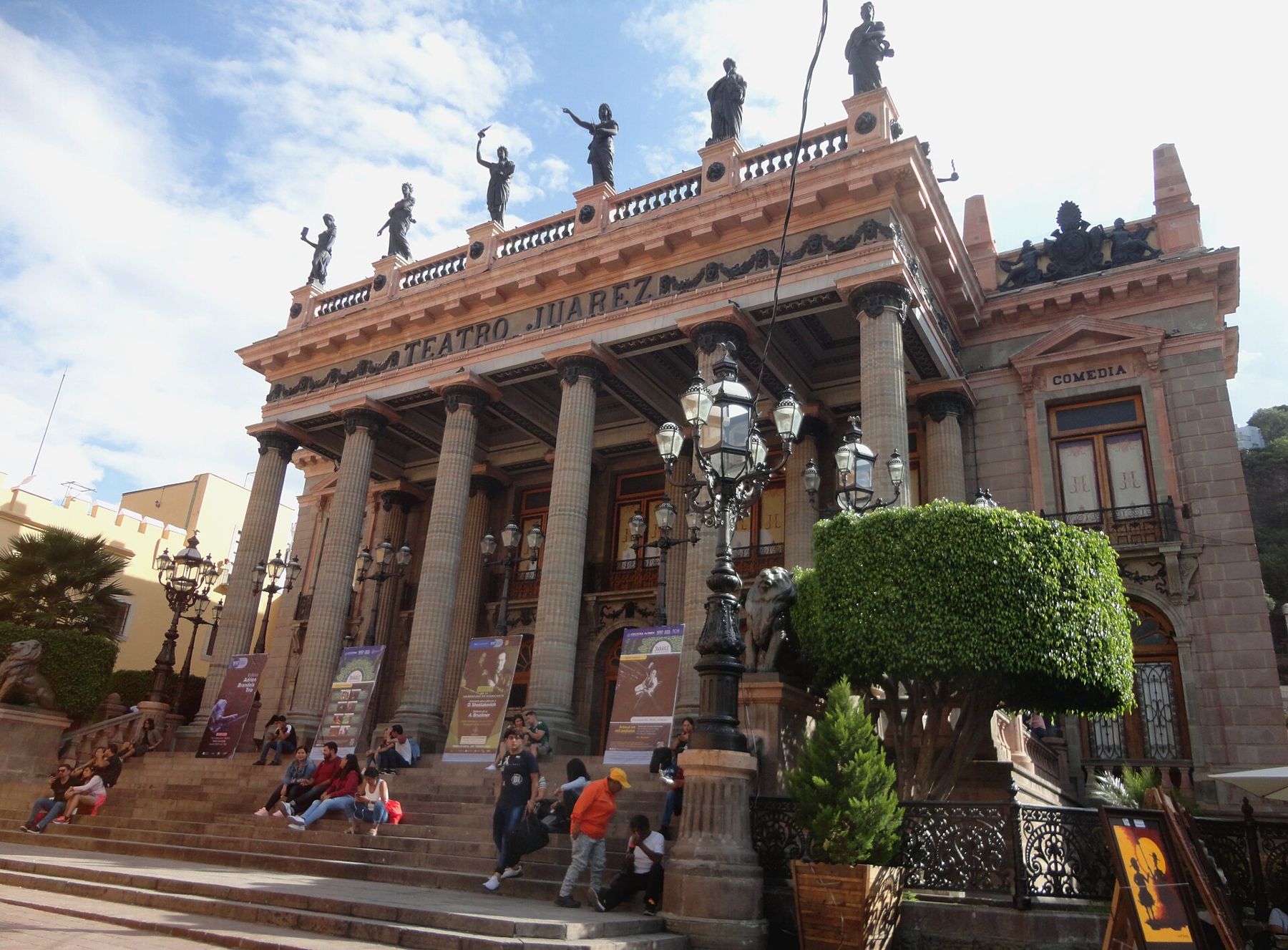
Across the street from the plaza rises the Teatro Juárez, and nothing in the town is quite so theatrical. Construction began in the 1870s and took decades; the building was finally inaugurated in 1903, with Porfirio Díaz, then president, present for the occasion. It belongs to that period completely: grand, confident and built to impress.
The façade is a portico of tall columns in grey and rose stone, carrying an entablature with the theatre's name in large letters. Along the roofline stands a row of bronze muses, dark against the sky, each with her own gesture and attribute. Lamps on elaborate iron posts stand at the foot of the columns, and a pair of bronze lions guards the wide flight of steps leading up to the doors.
Those steps are the theatre's second stage. On almost any afternoon they are full of people sitting in the sun, talking, eating, watching the plaza. It is one of the best seats in town and costs nothing. In the evening the steps catch the last light and then the glow of the lamps, and they become a gathering place for groups heading out to the walking serenades that start nearby.
Those steps are the theatre's second stage.
Inside the theatre
The interior is as surprising as the exterior is formal. Behind the classical front lies a horseshoe auditorium decorated in a Moorish-inspired style, with tiers of balconies wrapped in carved and painted woodwork, patterned walls in reds and golds, and an intricate ceiling of fretwork. Rows of wooden seats fill the stalls. The effect is warm, dense and a little dreamlike, a world away from the bright stone outside.
The theatre is a working venue, used for concerts, opera, dance and theatre, and it is one of the main stages of the Festival Internacional Cervantino each autumn. When it is not in use for performances it is often open for visits. Opening hours, visiting fees and performance schedules change, so check before you go.
If the plaza is the city's living room, the famous balconies a short climb away are its most told love story.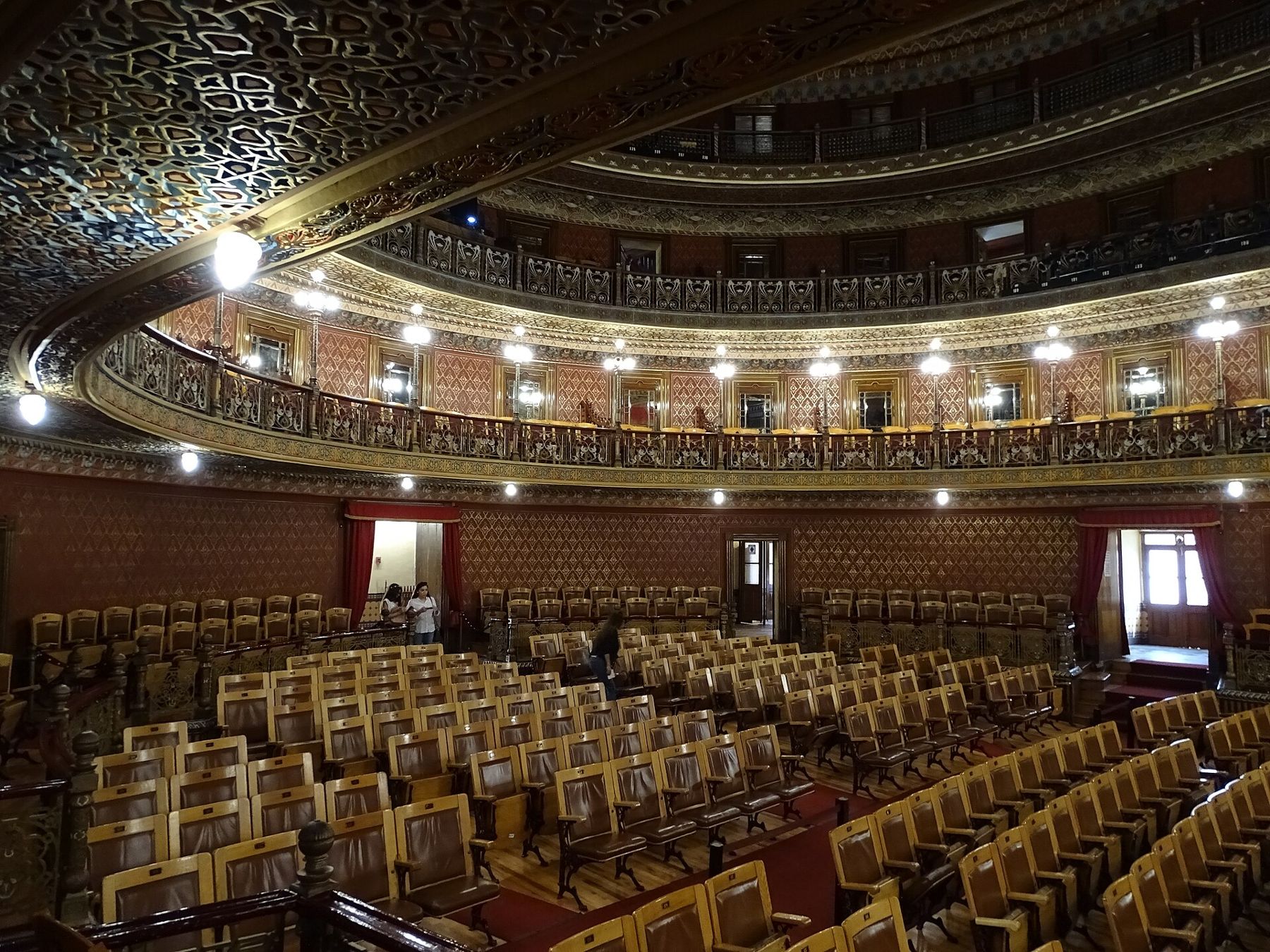
The Templo de San Diego
At the corner of the plaza, close to the theatre, stands the Templo de San Diego, the church of the old Franciscan convent. Its origins go back to the colonial period, and it has been rebuilt more than once over the centuries. The front you see today is carved stone in a richly ornamented baroque style, its surface crowded with columns, scrolls and niches. Look up at it in late afternoon, when the low sun brings out every detail of the carving.
Inside it is quiet and cool, a pause between the plaza and the busy streets beyond. It is an active church, so dress and behave as you would for any service, and avoid wandering around during Mass.
Evenings in the plaza
The plaza changes with the light. In the morning it is calm, swept and shaded, with a few people crossing on their way to work. By midday the benches are full. Toward evening the crowd thickens, the lamps come on beneath the laurels, and music starts.
Sometimes a band plays in the iron bandstand, especially on certain evenings of the week. More often you will hear mariachis and strolling musicians working the café terraces, playing on request. Groups of students in old-fashioned capes and tights gather on the theatre steps to start their singing walks through the alleys. It is noisy, cheerful and crowded, and it is a large part of why people love this city.
A few practical notes. Musicians at the café tables expect a payment if you ask for a song; agree the price first. Vendors pass through with snacks, balloons and souvenirs; a polite no is enough. Evenings at around 2,000 metres turn cool quickly, even after a warm day, so bring a layer. During the Cervantino and holiday weekends the plaza can be packed late into the night.
From here the rest of the centre is a short walk away. The street leading west takes you past churches and old mansions toward the basilica and the university steps, while the alleys climbing the hillside behind the theatre lead up toward El Pípila and its view over the whole valley.