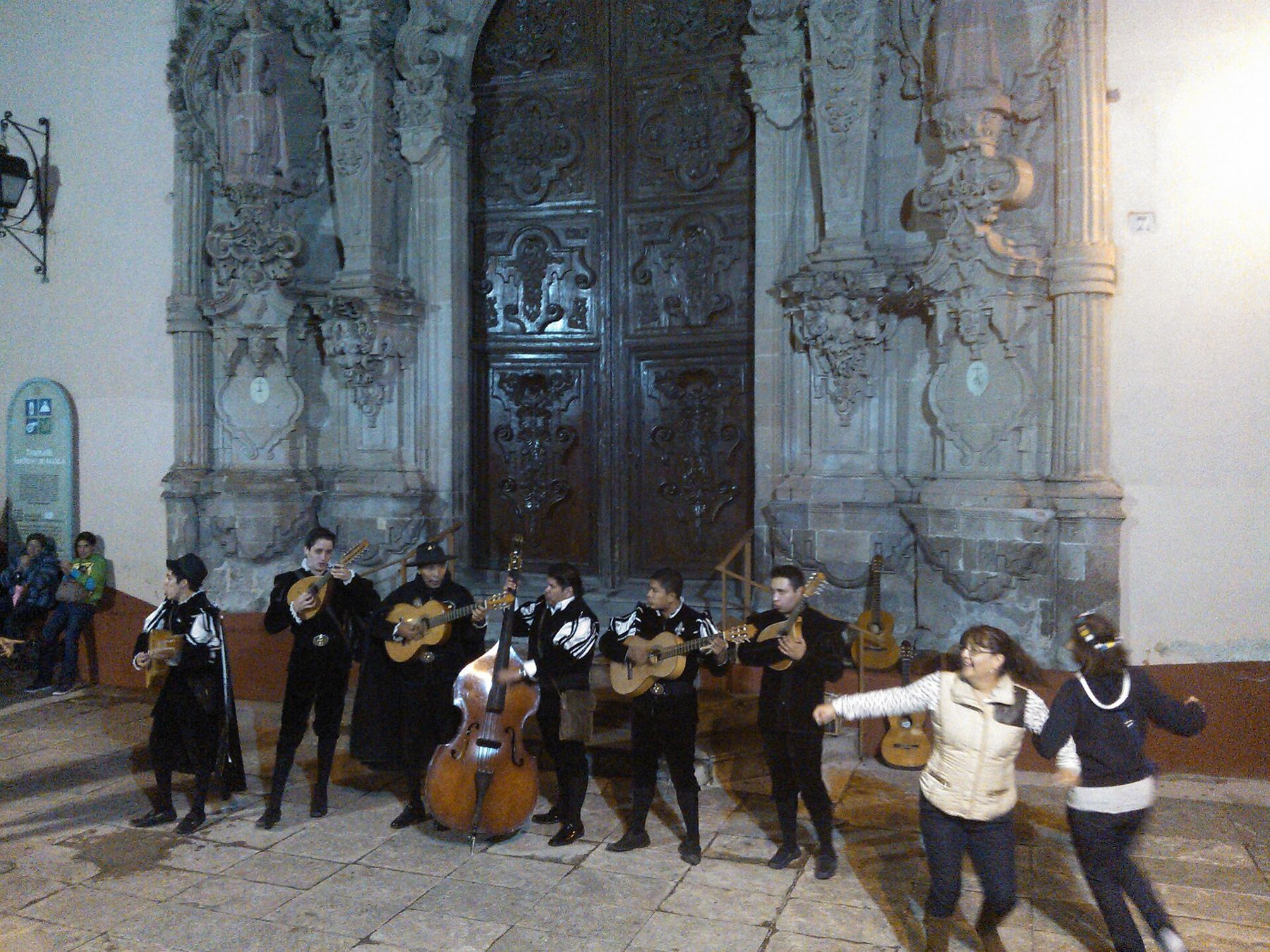
As evening settles over Guanajuato, a different sound joins the traffic hum and the church bells: guitars, mandolins, a double bass and a tambourine, and a crowd singing along a little out of time. Turn toward it and you will probably find an estudiantina, a group of musicians dressed like students from old Spain, gathering people for a callejoneada. The word comes from callejón, alley, and that is exactly what it is: a walk through the alleys, led by song.
What an estudiantina is
Estudiantinas are student musical groups with roots in the student bands of Spanish universities, which roamed the streets singing for their supper centuries ago. Guanajuato, as a university town with a strong Spanish colonial past, took the tradition to heart, and its groups have become part of the face of the city.
You know them by the costume. The musicians wear dark doublets and breeches in a Spanish Renaissance style, often with puffed and slashed sleeves, white collars or cuffs, dark stockings and soft shoes or boots. Over the shoulders goes a long black cape, and from the cape hang ribbons in many colours. The look is theatrical and a little old-fashioned on purpose, which suits a city full of baroque church fronts and stone balconies.
Where the walks begin
Many callejoneadas gather near the Jardín de la Unión, the triangular plaza of clipped laurels at the heart of the old town, and often around the steps of the Teatro Juárez or the stone front of the Templo de San Diego. In the evening the musicians appear in costume, play a few songs to draw a crowd, and sell places on the walk. When enough people have joined, the group sets off.
From there the route climbs. The exact path varies by group and by night, but the walks head into the narrow streets and stairways above the centre, stopping in small plazas and at corners where the walls bounce the sound back. Some routes pass close to the Callejón del Beso, where the musicians may pause to tell the legend of the lovers whose balconies almost touched.
How joining works
Joining a callejoneada is usually as simple as paying the group. Members in costume walk through the crowd near the starting point, explain the route and the timing, and collect payment from those who want to come along. Some groups offer extras, and on a busy weekend several groups may be working the plaza at once, each with its own style of songs and banter.
Prices, timings and what is included change from group to group and season to season, so ask before you pay and check what the walk covers. Look for a group whose members are clearly in costume and leading a visible crowd, and agree on the details out loud. It is also fine just to listen for a while at the start before deciding. If you would rather learn the lanes first, the alleys are just as open to you by day, at your own pace and on your own route.
On the walk
Once the music starts moving, the evening becomes part concert, part comedy show and part stroll. The musicians sing traditional songs, ballads and boleros, many with choruses that the crowd picks up quickly even if they do not speak Spanish. Between songs they tell jokes, tease the audience and share stories about the alleys you are walking through, some historical, some plainly legends, and many told for laughs.
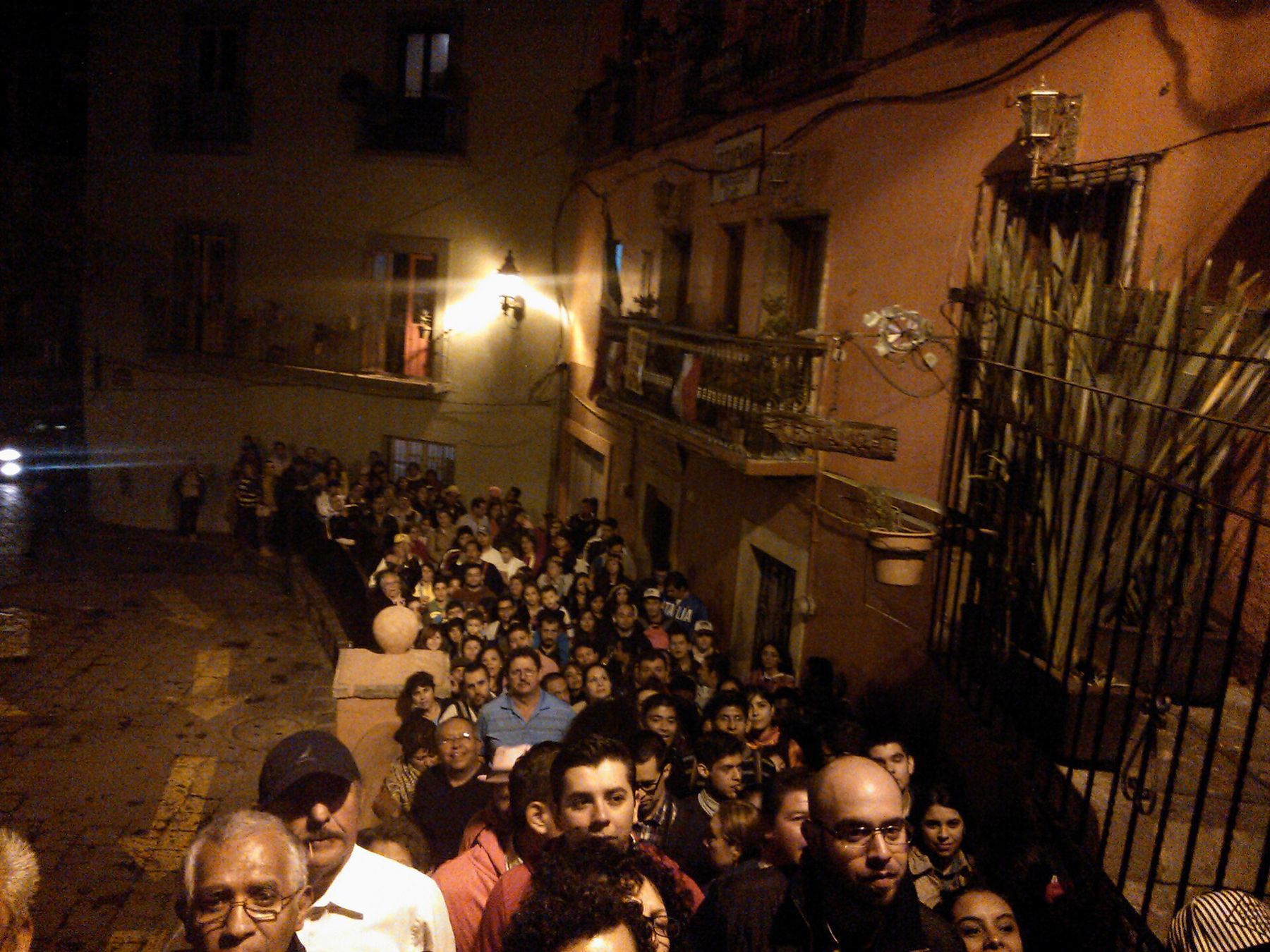
The crowd is usually a mix of Mexican visitors, students and travellers from abroad, all squeezed into lanes barely wider than a doorway. Expect a lot of clapping, some dancing at the stops and plenty of photos taken by the light of iron lanterns. At the end the group usually plays a last song or two in a small square and says goodnight, leaving you somewhere up the hill to find your own way down. By daylight the same stairways look entirely different, with the sun on the painted walls.
The climb and the night air
The alleys of Guanajuato are steep, and a callejoneada does not avoid them. You will climb stone steps, walk on uneven paving and stand in packed groups on slopes. Shoes with grip matter more than anything else. If stairs are hard for you, ask the group about the route before you pay, since some walks climb more than others.
The city sits at around 2,000 metres. Even after a warm day the nights can turn cool quickly, so bring a layer. Stay with the crowd, keep your belongings close in the tight lanes, and know your way back to a main street or plaza at the end. These are popular, social walks, but the usual city sense at night still applies.
When to go
Callejoneadas run through much of the year, most visibly in the evenings and especially on weekends and holidays, when the Jardín de la Unión is at its fullest. During the Festival Internacional Cervantino, usually in October, the city is crowded and the walks are part of the general celebration, so expect bigger groups and fuller alleys. Quieter weeknights give you more space to hear the music and see the lanes.
Schedules are informal and can change with weather, season and demand. If you have a particular evening in mind, go to the plaza early, listen to the groups and ask what is planned that night.
Why it suits this city
A callejoneada makes sense only in a place like Guanajuato. The streets are too narrow for cars, the stairs too steep for anything but feet, and the walls close enough to throw back every chord. The estudiantinas turn that tight, vertical maze into a moving stage, and for an hour or so you see the old town the way it was built to be used: on foot, in company, with music echoing off the stone.