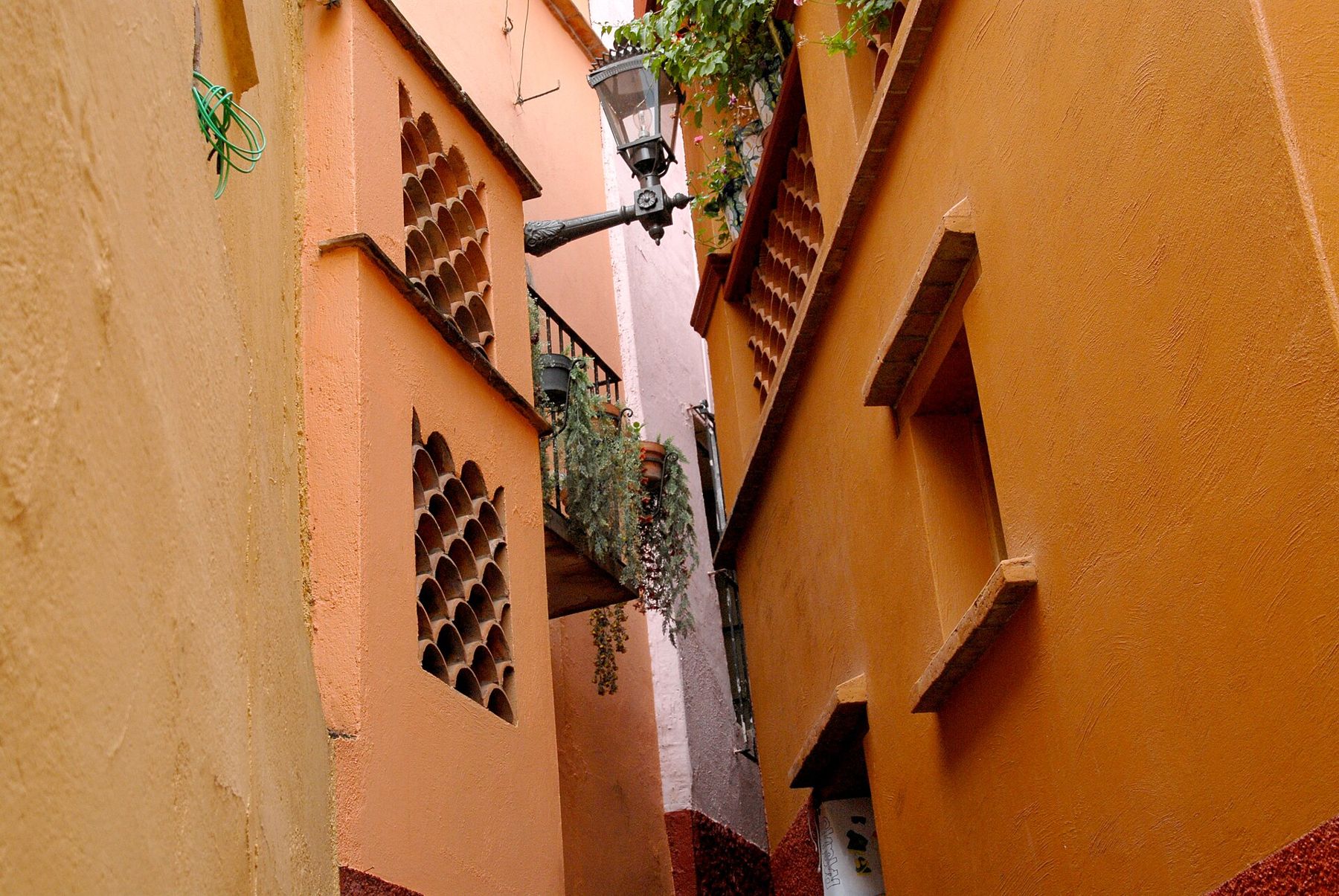
Guanajuato has hundreds of alleys, and most of them are steep, painted and narrow. One of them gets a queue. The Callejón del Beso, the Alley of the Kiss, is a short, crooked passage climbing a hillside a few minutes from the centre, and what draws people is a single detail: two balconies, one on each side, that hang so far over the lane that the people standing on them could reach across and touch hands. Everything else, the legend, the custom on the steps, the crowd with cameras, has grown around that one gap of air.
It is worth going. It is also worth going at the right hour, with the right expectations, and with the story held at the proper distance. This is a walk of a few minutes on the ground and a much longer one in the imagination.
Finding the alley
The lane rises from a small square below, the Plazuela de los Ángeles, and like most of the city's callejones it climbs rather than runs. From the central plazas you walk a short way along the valley floor and then turn up into the slope; ask anyone for the Callejón del Beso and they will point. The approach is part of the pleasure: walls in ochre, terracotta and pale rose, iron lamps on brackets, potted geraniums on every ledge, and the echo of footsteps bouncing between houses that stand closer than a pair of outstretched arms.
If you already know how to read the city on foot, the way up will feel familiar. If you do not, the notes on walking the callejones covers the habits that make the whole old town easier: follow the slope, watch the tiled signs, and accept that you will get a little lost.
The street itself is paved in stone and broken by shallow steps. It is not long. You can walk its length in a minute or two, and the famous stretch is a matter of a few metres where the walls pinch in and the upper floors lean out.
The balconies, close enough to touch hands
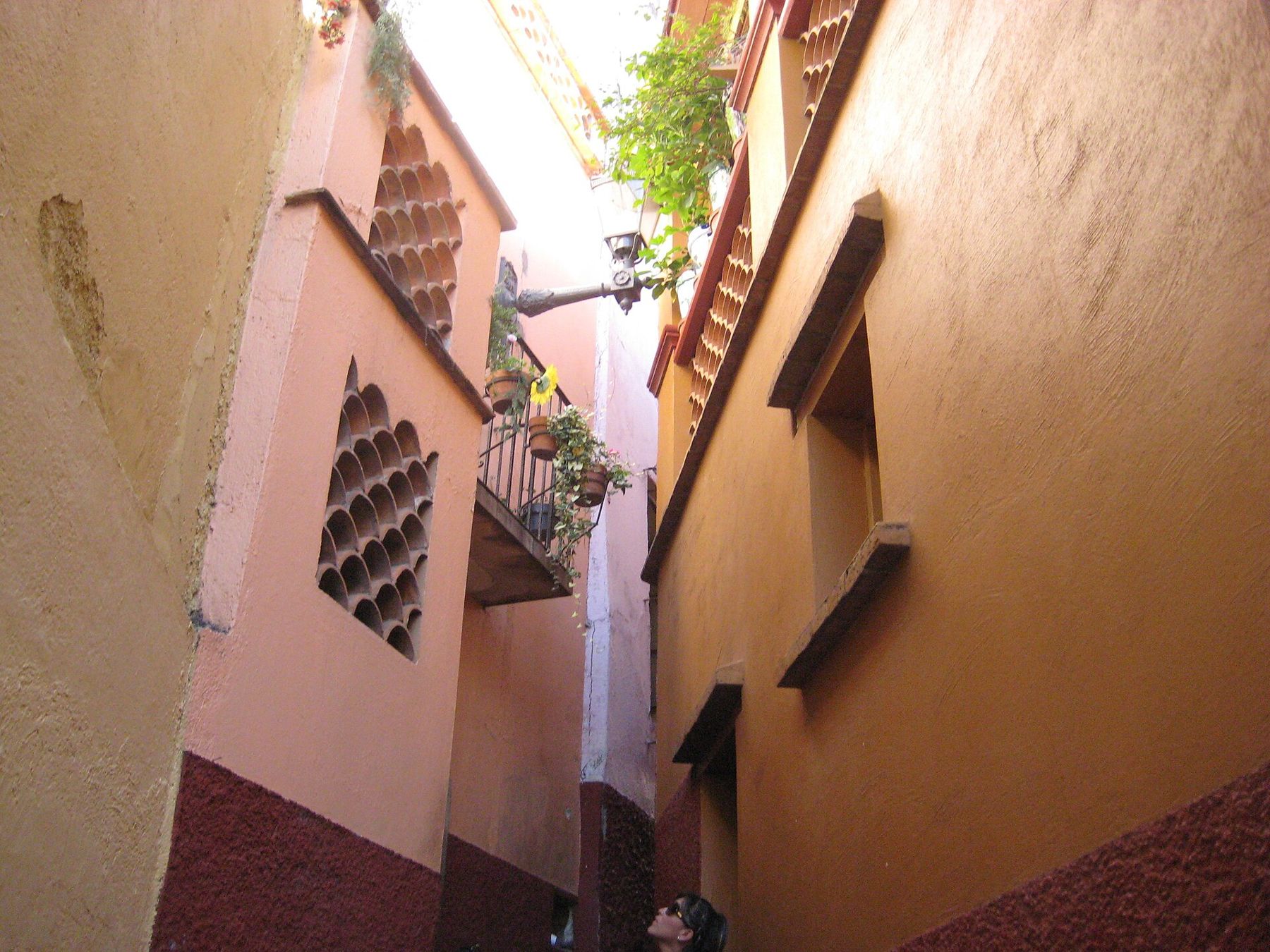
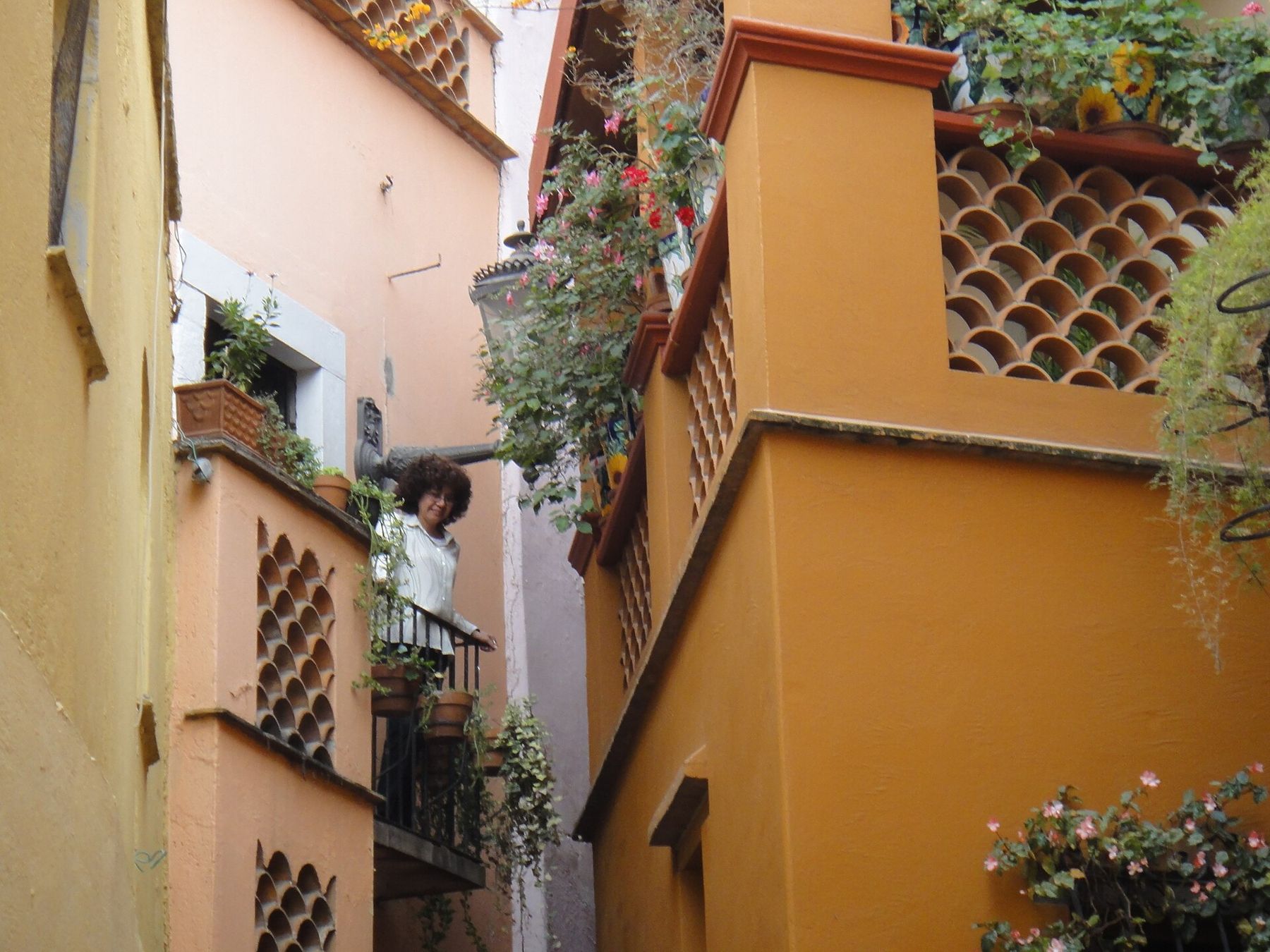
Look up before you look at anything else. On the left, a pink house carries a small iron balcony hung with ferns and trailing ivy; on the right, an ochre house juts out above the lane with its own window and ledge. Between them the gap is so narrow that the facades seem to be leaning in to whisper. Above, a lantern on a curling iron arm hangs into the space, and beyond it is a thin strip of sky.
The architecture explains itself once you notice the ground. Guanajuato grew in a tight ravine where flat land was scarce, so houses were built tall and, wherever they could be, they reached outward on upper floors to win a little more room. Along most alleys that habit just makes the passage dim and cool. Here two houses happen to have pushed toward each other at exactly the same height, and the result became the most photographed few metres in the city.
Notice the details too. The walls are washed in warm earth colours, ochre on one side and salmon on the other, with a deep red band along the base where feet and rain do their damage. Some upper walls are pierced with screens of curved clay tiles laid in rows like fish scales, letting air through while keeping the inside private. Flowers spill from pots on every balcony that can hold one.
The legend, told as a legend
Every version of the story agrees on its shape, and that is the clearest sign it is a legend rather than a record. A young woman, usually called Doña Carmen, lives in one of the houses with a strict and wealthy father. A young man, usually called Don Luis, of modest means, falls in love with her. Forbidden to see her, he takes the house across the alley, and the two lovers meet balcony to balcony, close enough to touch hands across the gap.
The ending is sad. In the most common telling the father discovers them and, in his anger, kills his daughter, and Don Luis is left holding her hand across the alley as she dies. Some versions add more, some less, and the names and details shift from teller to teller. Nobody can point to a document, and that does not matter. The story belongs to the city in the way songs do, and it is told the same way you would tell a ghost story by a fire: with feeling, and without asking you to believe every word.
Out of that tale has grown a cheerful custom. Couples climb to a particular step below the balconies, usually said to be the third, and kiss there. The tradition promises years of good luck to those who do, and the opposite to couples who skip it. You will see people taking it seriously, and others laughing as they do it. Both seem to be the point.
Nobody can point to a document, and that does not matter.
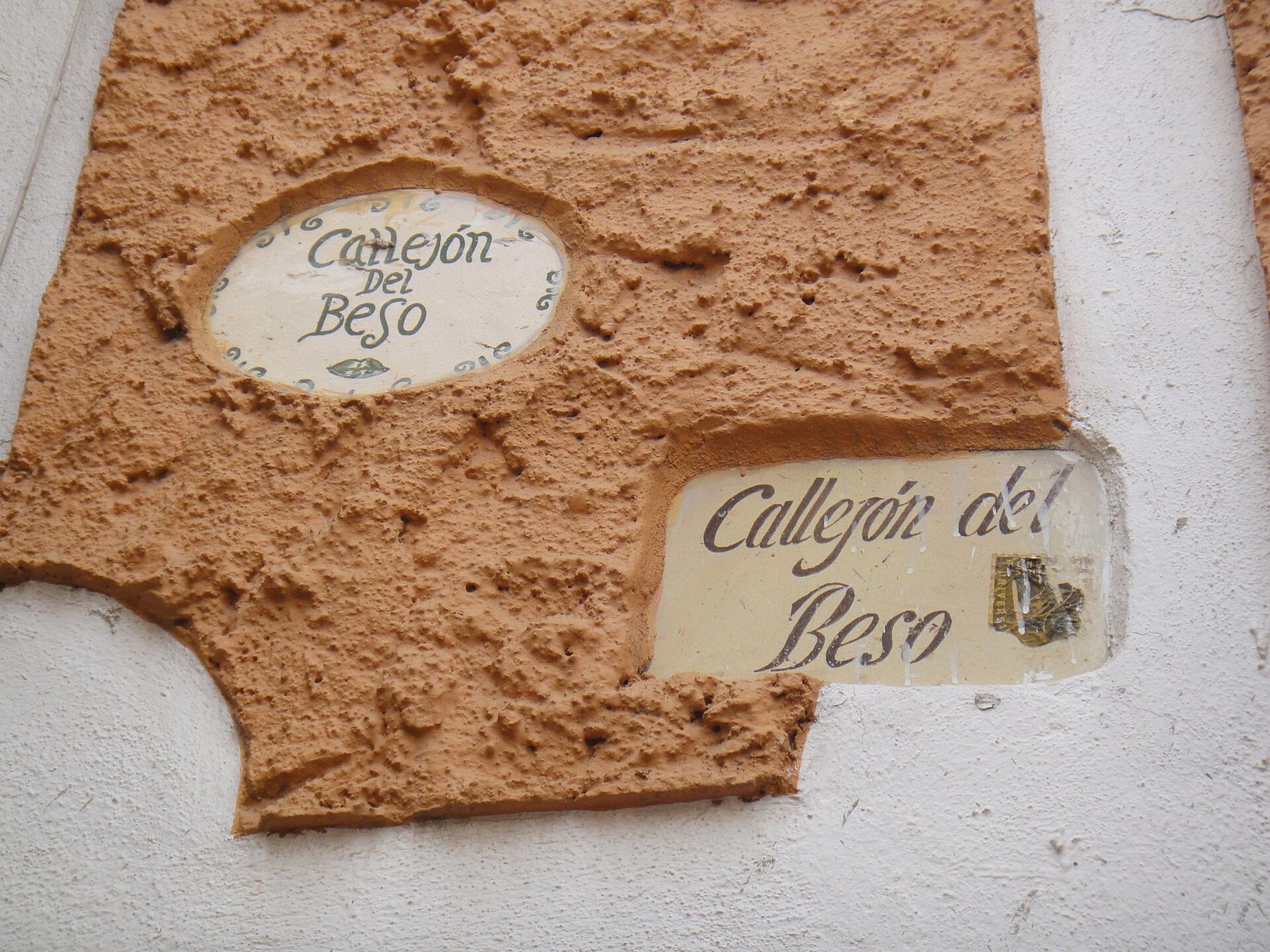
Names like this one are everywhere in Guanajuato, and many of them carry a story of their own. If you enjoy the way a tiled sign can hold a whole tale, the city's other alley names reward the same attention.
The crowd, and the quiet hours
For much of the day, especially at weekends and on holidays, the alley is full. Groups gather on the steps, couples wait their turn for the kissing step, and people take photographs looking up at the balconies. Some houses along the lane may open their balconies to visitors at certain times; arrangements change, so treat anything like that as something to check on the spot rather than something to count on.
The alley is a different place early in the morning. Before the city is fully awake, the stone is cool, the light comes down soft and indirect between the walls, and you can hear water dripping from freshly watered pots. That is when the colours read best and when you can stand under the balconies long enough to really look at them. Late in the evening, once the crowds thin, the lantern overhead gives the lane a warm, theatrical glow.
Weekday mornings are the easiest time to find a gap. During the October festival and holiday weeks the whole city is busier, and the alley is busier still; if you are visiting then, plan for a short wait or come back. The walking serenades that wind through the alleys at night sometimes pass this way, when the story is sung as much as told.
Walking on from the alley
The Callejón del Beso is short, but it is a doorway into a whole hillside of lanes. Keep climbing and the streets grow steeper and quieter, the houses smaller, the paint brighter. Small stairways branch off, some ending at a front door, some opening onto a ledge with a view across rooftops toward the domes of the centre. You leave the queue behind within a minute or two.
Going down, you are soon back in the valley among the plazas. The tree-shaded triangle of the Jardín de la Unión is a natural place to sit afterwards, with the steps of the Teatro Juárez close by. On a clear day it is also worth heading up the opposite hillside to the monument to El Pípila, where you can look back across the valley and try to pick out the slope you just climbed.
Practical notes
- The alley is short, but it is stepped and uneven. Wear shoes with grip, especially after rain, when worn stone can be slippery.
- Guanajuato sits at around 2,000 metres. The sun is strong at midday and the nights are cool, so carry a layer if you plan to come back after dark.
- Keep to the edge of the steps when you stop for a photograph; the lane is a working route for the people who live on it.
- The houses here are homes. Look up as much as you like, but keep doorways clear and voices down early and late.
- As anywhere busy, keep an eye on your bag in a tight crowd, and stick to well-used lanes after dark.
Above all, give yourself a few minutes simply to stand still under the two balconies. The legend is lovely, and the custom on the step is fun, but the real pleasure is the thing itself: two old houses leaning toward each other across a strip of sky, so close that, if you stood on one and a friend stood on the other, you could reach out and touch hands.