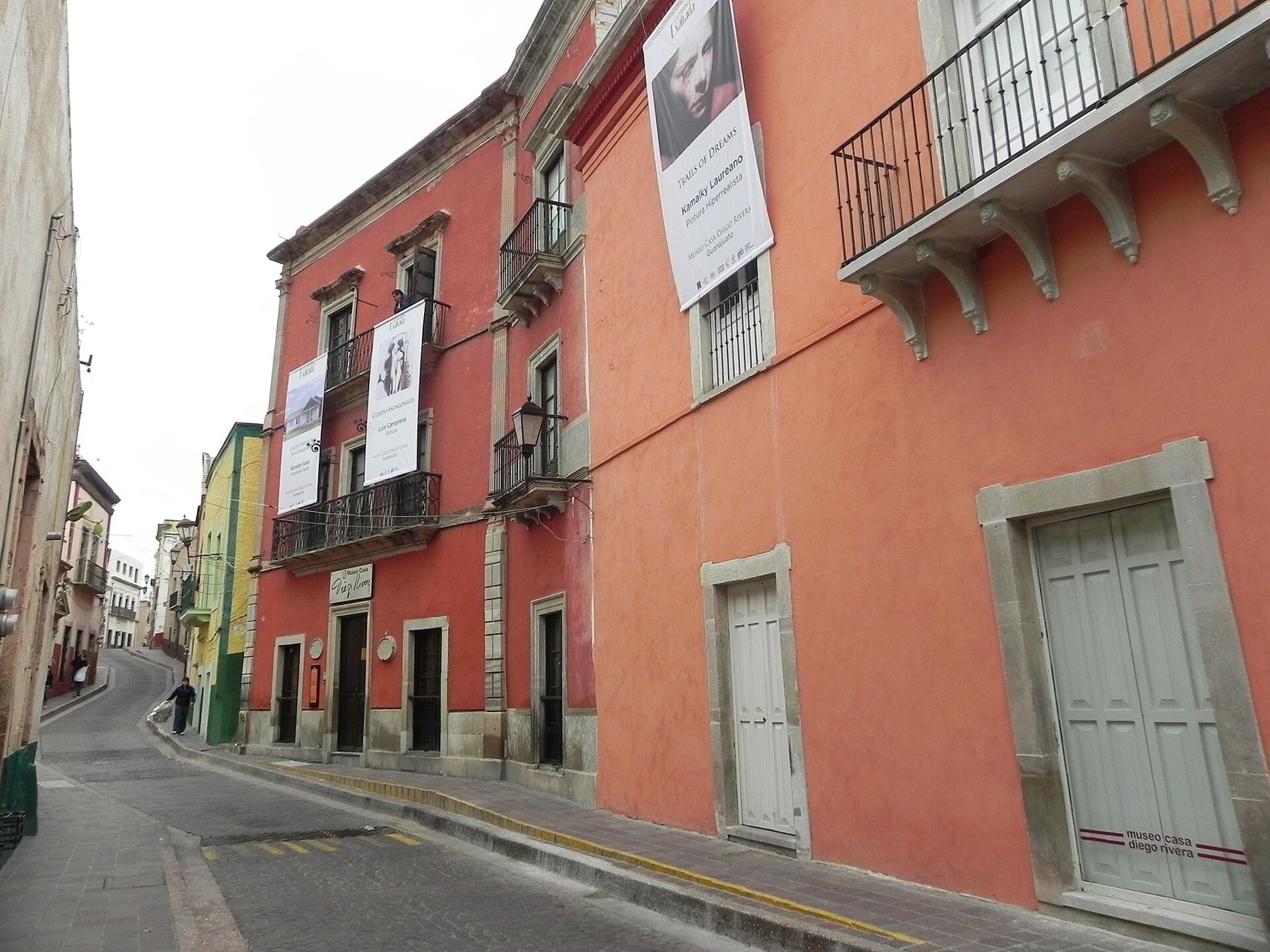
Diego Rivera is so tied to Mexico City, to its murals and its palaces, that many visitors are surprised to learn he was born in Guanajuato. He was, on 8 December 1886, in a house on Calle Positos, a short, steep street a few minutes' walk from the centre. The house is now a museum, and visiting it is a quiet way to meet the painter before he became a public figure.
The street matters as much as the house. Calle Positos is narrow and sloping, lined with facades in red, ochre, yellow and green, with iron balconies hanging over the pavement. It is the Guanajuato of the callejones, and it is easy to imagine a small boy growing up among these walls.
Finding Calle Positos
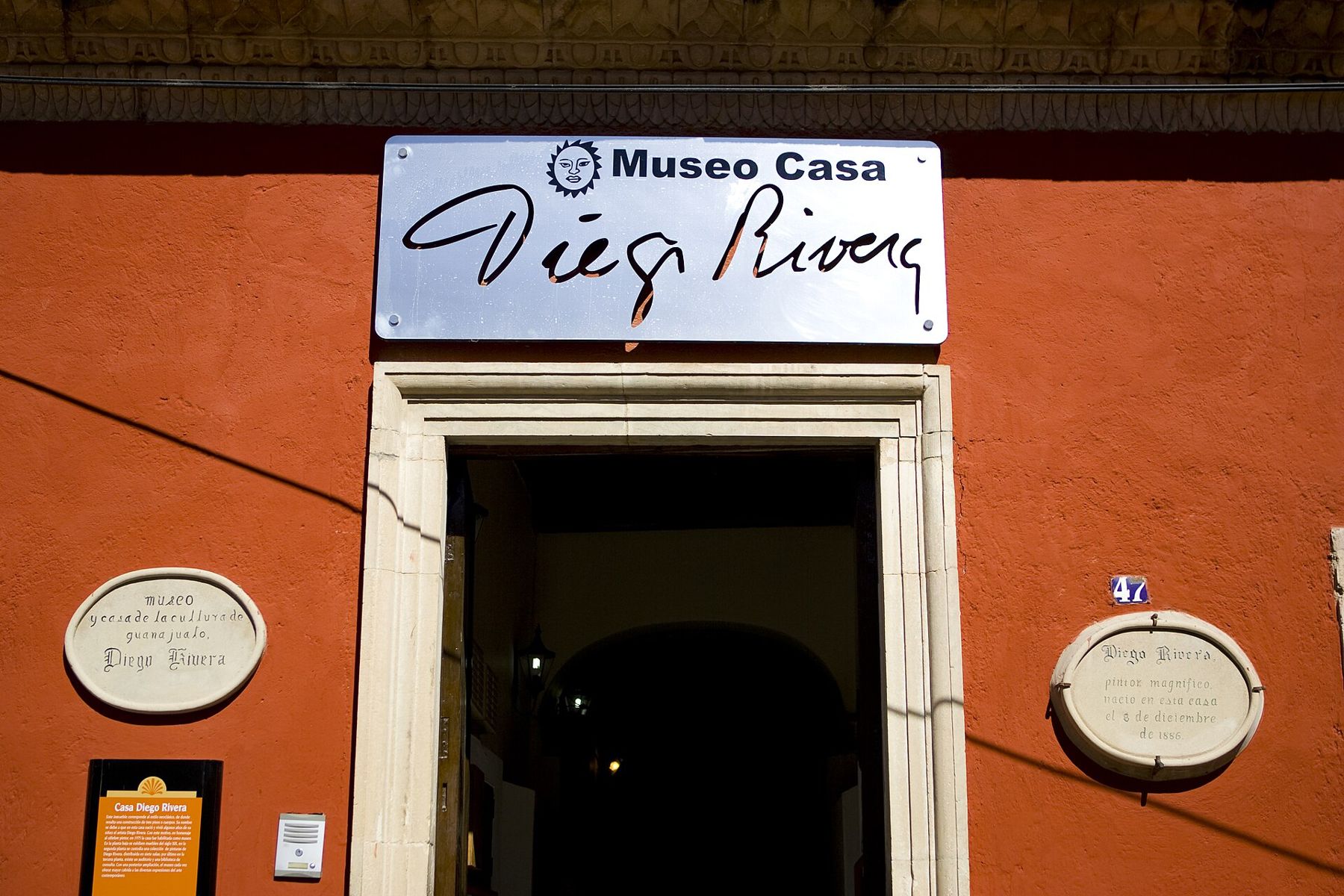
From the plazas at the heart of the city, the street climbs gently away from the valley floor. The museum is at number 47, a tall house painted deep red with stone frames around its doors and windows. Banners for current exhibitions often hang from the upper balconies. If you are walking from the basilica and the university steps, it is only a few minutes away, and the route is a good introduction to how the old town fits together.
A birthplace and its plaques
Beside the door, two oval stone plaques set into the red wall mark the house. One names it as the museum; the other records, in simple old-fashioned lettering, that the painter was born in this house on 8 December 1886. It is a modest marker for a man whose murals cover entire walls elsewhere, and that modesty suits the place.
Rivera was born a twin; his brother died in infancy. The family left Guanajuato for Mexico City when Diego was still a small child, so his memories of the city were brief. Yet Guanajuato kept the connection, and the house was eventually restored and opened as a museum in his honour.
The building itself repays a slow look. The facade is tall and plain, washed in a deep earthy red, with grey stone framing every opening and a band of carved stone running under the roofline. Wrought-iron balconies rest on curling stone brackets, and the wooden doors are heavy and panelled. Across the street the houses step up the hill in yellow and green, so the red front glows between them, especially in the late afternoon.
What you see inside
The museum is spread over several floors. On the ground floor, rooms are furnished in the style of a well-off nineteenth-century household, with heavy wooden furniture and the kind of objects a home of the period might have held. It is a recreation rather than the family's own belongings, but it gives a sense of the house as a home.
The upper floors hold the art. The collection centres on Rivera's work, much of it from his early years: drawings, studies and paintings that show him learning, experimenting, and moving through different styles, including the period he spent in Europe when he worked in a Cubist manner. Sketches for larger projects let you see how his ideas took shape before they reached the wall.
Other rooms are used for temporary exhibitions, often of contemporary Mexican and international artists, and for talks and events. Exhibitions change, so what you find on any given day will vary.
Rivera and the city's art
The path from this house to the great murals was long. After his family moved to the capital, Rivera trained at the Academy of San Carlos, then spent many years in Europe, mostly in Spain and France, before returning to Mexico in the early 1920s. There he became one of the leading figures of the mural movement, covering public buildings with scenes of Mexican history, labour and everyday life. The rooms on Calle Positos show the beginning of that road rather than its end.
Seeing the early work here makes a useful counterpoint to the murals Rivera is famous for. The confident, public painter of later years is not yet present; instead you find a young artist still testing his hand. For anyone interested in Mexican mural painting, the visit pairs well with the murals inside the Alhóndiga de Granaditas, painted by another artist, which tell the story of the region's history on a grand scale.
Guanajuato itself is a city of art. The university, the theatres and the festival keep it full of painters, musicians and actors, and the house on Calle Positos is part of that life rather than a shrine set apart from it. During the Festival Internacional Cervantino, usually in October, the museum and the streets around it can be busier than usual.
Planning the visit
An hour or so is enough for most visitors, longer if a temporary exhibition catches you. Opening days, hours and entry fees change, and the museum may close on certain days of the week, so check before you go.
- Go in the morning on a weekday for the quietest rooms.
- Expect stairs between floors; the house is old and not all spaces are step-free.
- Follow the museum's posted rules on photography.
- Combine the visit with a slow walk through the surrounding alleys.
Around the street
When you step back out onto Calle Positos, take a moment before moving on. Look up at the iron balconies, the lamps on their brackets, the colours stepping up the slope. A few minutes' walk in one direction brings you back to the busy centre; in the other, the streets climb into quieter neighbourhoods. Either way, you walk through the same kind of streets that surrounded Rivera in his first years, in a city that kept him even after he left.