Every walk in Guanajuato eventually wants to see the city from above. The streets are so tight and the lanes so twisted that down among them you only ever see a slice: a strip of sky, a painted wall, a stair turning out of sight. On the southern slope above the centre, a giant stone figure stands with a torch held over his head, and the terrace at his feet is the place where all those slices join into one picture. This is El Pípila, and the climb to him is one of the classic small journeys of the city.
You can do it in a few minutes by funicular or in half an hour or so by alleys and steps. Either way, you arrive at the same balustrade, and the view is the reward.
The figure on the hill
The monument was inaugurated in 1939. It is a massive figure in pinkish stone, a broad-shouldered man in plain clothes with a slab on his back and a torch thrust upward, raised high enough that you can see him from many corners of the town below. Close up, the scale is hard to take in; from the plazas he looks like a guardian standing on the rim of the ravine.
The figure honours El Pípila, the name tradition gives to a miner said to have taken part in the insurgent attack on the Alhóndiga de Granaditas in September 1810. In the story most people in Guanajuato know, he tied a flat stone to his back as a shield against the shots from above, crawled to the granary's great wooden door, and set it alight, opening the way for Miguel Hidalgo's insurgents. The man is usually identified as Juan José de los Reyes Martínez.
How much of that happened as told is a question historians still debate. Some details rest on later accounts, and there have long been doubts about who did what at the door. That does not make the figure any less important to the city. El Pípila stands for the ordinary miner who took a risk in the first days of the War of Independence, and the town has adopted him as its own. If you want the fuller history of that September day and what followed, the granary itself is the place to go, and the Alhóndiga de Granaditas tells it plainly.
Getting up there
The easy way is the funicular. Its lower station sits just behind the Teatro Juárez, a short walk from the laurels of the Jardín de la Unión, and the car climbs the hillside on a steep track to an upper station close to the monument. The ride is short, and the window gives you a quick lesson in how sharply the houses are stacked. Hours and fares change and there can be queues at busy times, so check before you go and allow for a wait in festival weeks and on holiday weekends.
The other way is on foot, and it is worth doing at least once, preferably going up rather than coming down in the dark. Several alleys climb the slope behind the theatre and the streets around it, and small signs point the way toward the monument. The lanes turn into stairways, the stairways into narrower lanes, and you pass doorways, potted plants and small landings where neighbours sit out in the evening. Expect a steep, uneven climb on stone steps. Take it slowly: the city sits at around 2,000 metres, and the thin air makes the last flights feel longer than they look.
Festival weeks change the climb too: lanes fill with visitors and the funicular queue grows.Coming down, you can reverse the route, ride the funicular, or take a different alley and see where it drops you. Most lanes on this side lead back toward the centre sooner or later.
What you are looking at
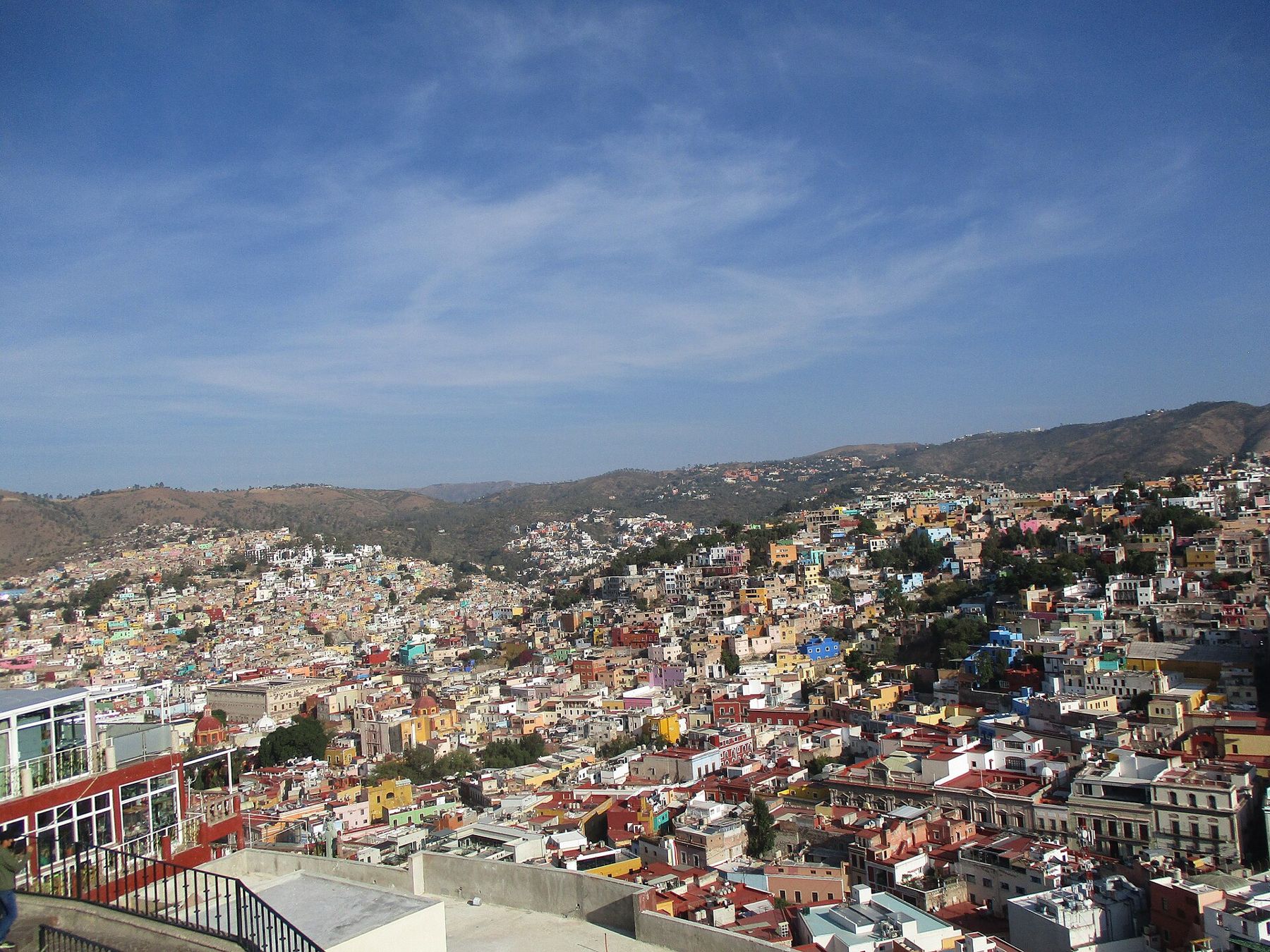
The first thing you notice is colour. The ravine below is packed solid with houses painted ochre, rose, sky blue, lime and brick red, climbing both slopes so densely that roofs and walls seem to be stacked on top of each other. Beyond them the bare brown hills close the valley in on every side.
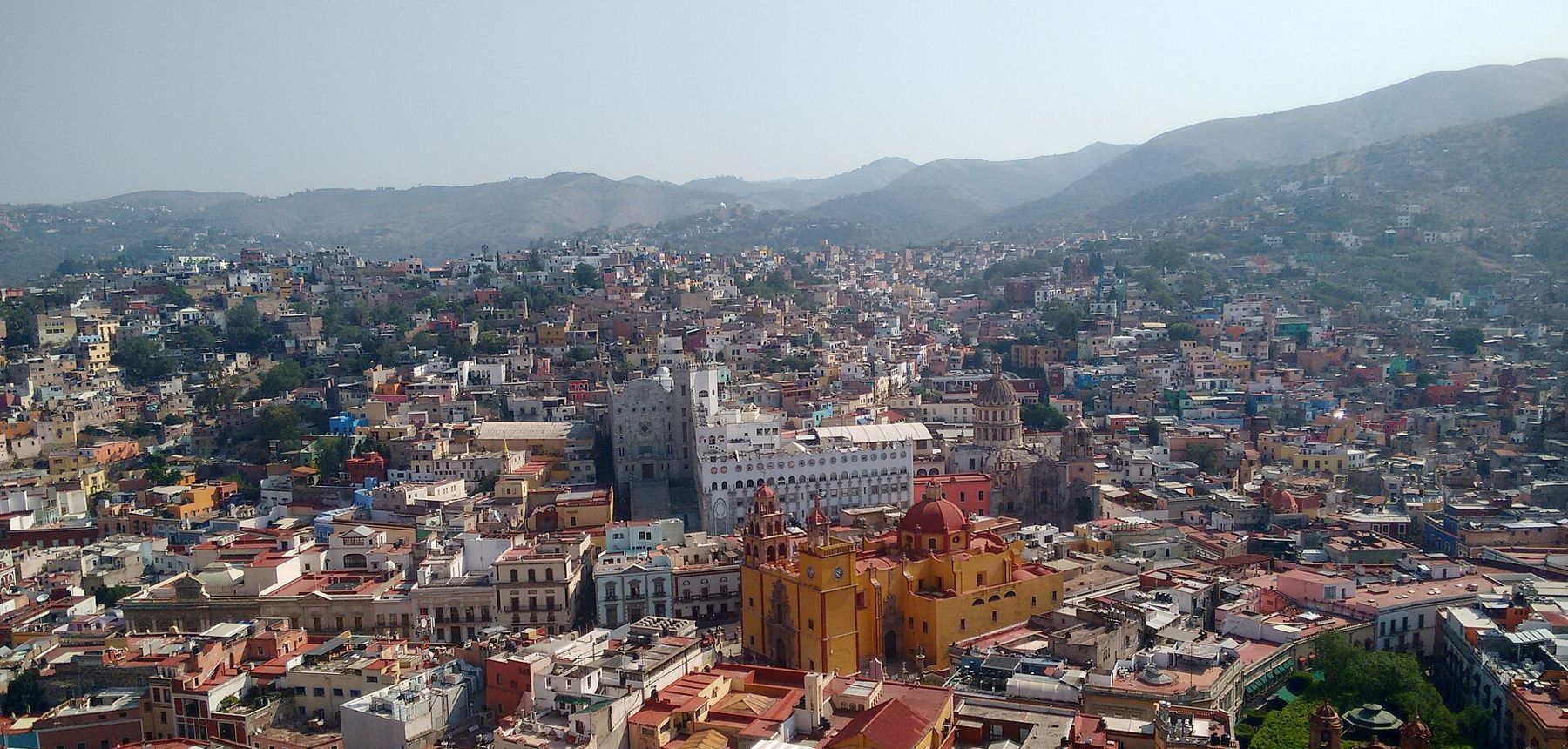
Then the landmarks start to pick themselves out. The big yellow church with the red dome and twin towers is the Basílica de Nuestra Señora de Guanajuato. Just behind it rises the pale stone front of the University of Guanajuato, with its long, many-windowed wing beside it, and beyond that the grey dome of the Templo de la Compañía. Down to the right, a reddish dome near the trees marks the Templo de San Diego beside the Jardín de la Unión. The basilica and the university steps look very different from up here: you see how they fit into the crowded centre rather than how they tower over the street.
Streets that felt like a maze turn out to follow the line of the valley floor, and the jumble of houses resolves into ribs of lanes climbing the slopes. From up here, the city finally makes sense as a single shape.
From up here, the city finally makes sense as a single shape.
What you cannot see is just as interesting. Under the floor of the valley run the old river bed and the road tunnels under the city, carrying traffic beneath the plazas you are looking down on. In October, when the festival fills the streets below, the hill is one of the few calm places left to take it all in.
When to go up
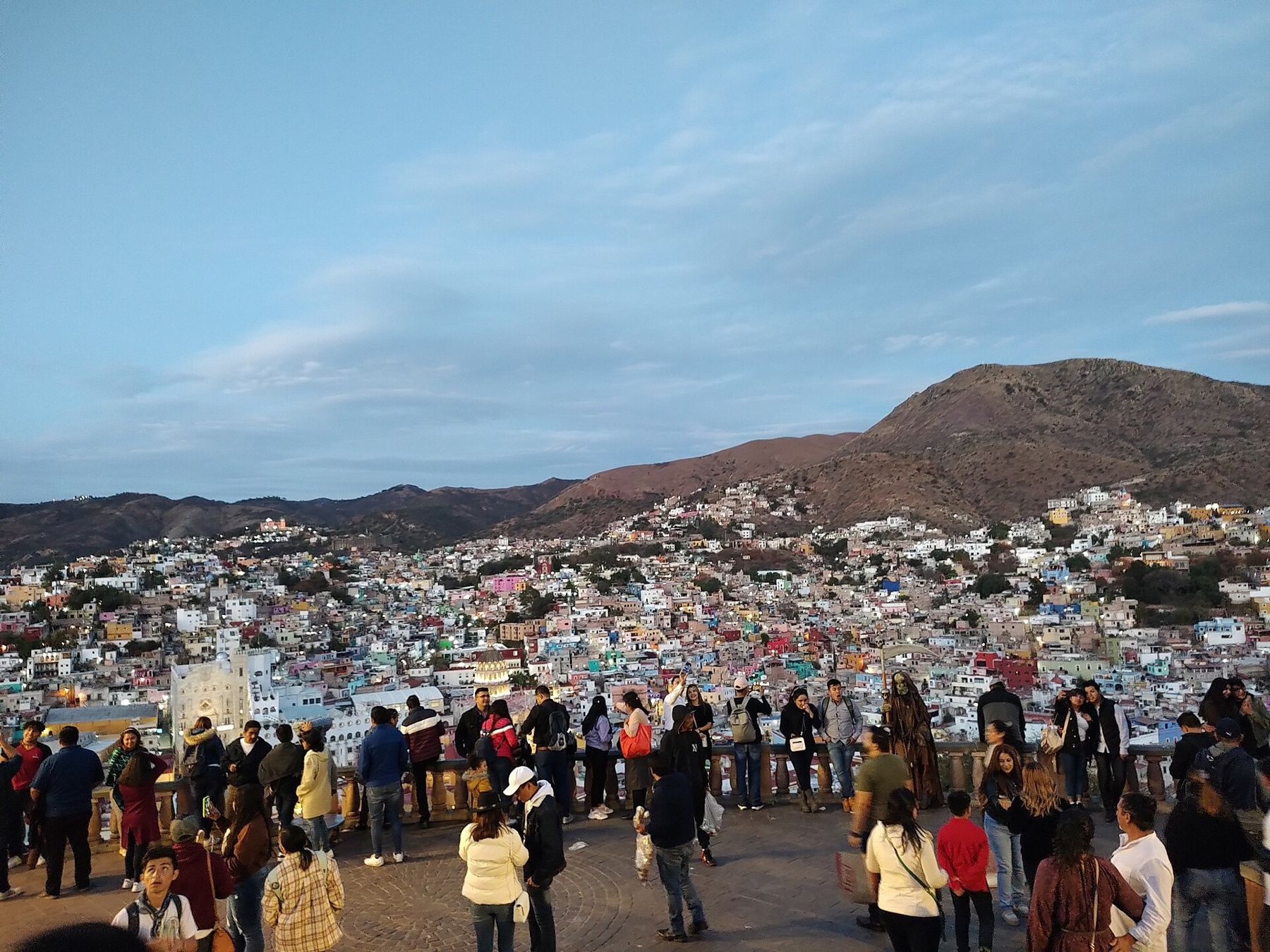
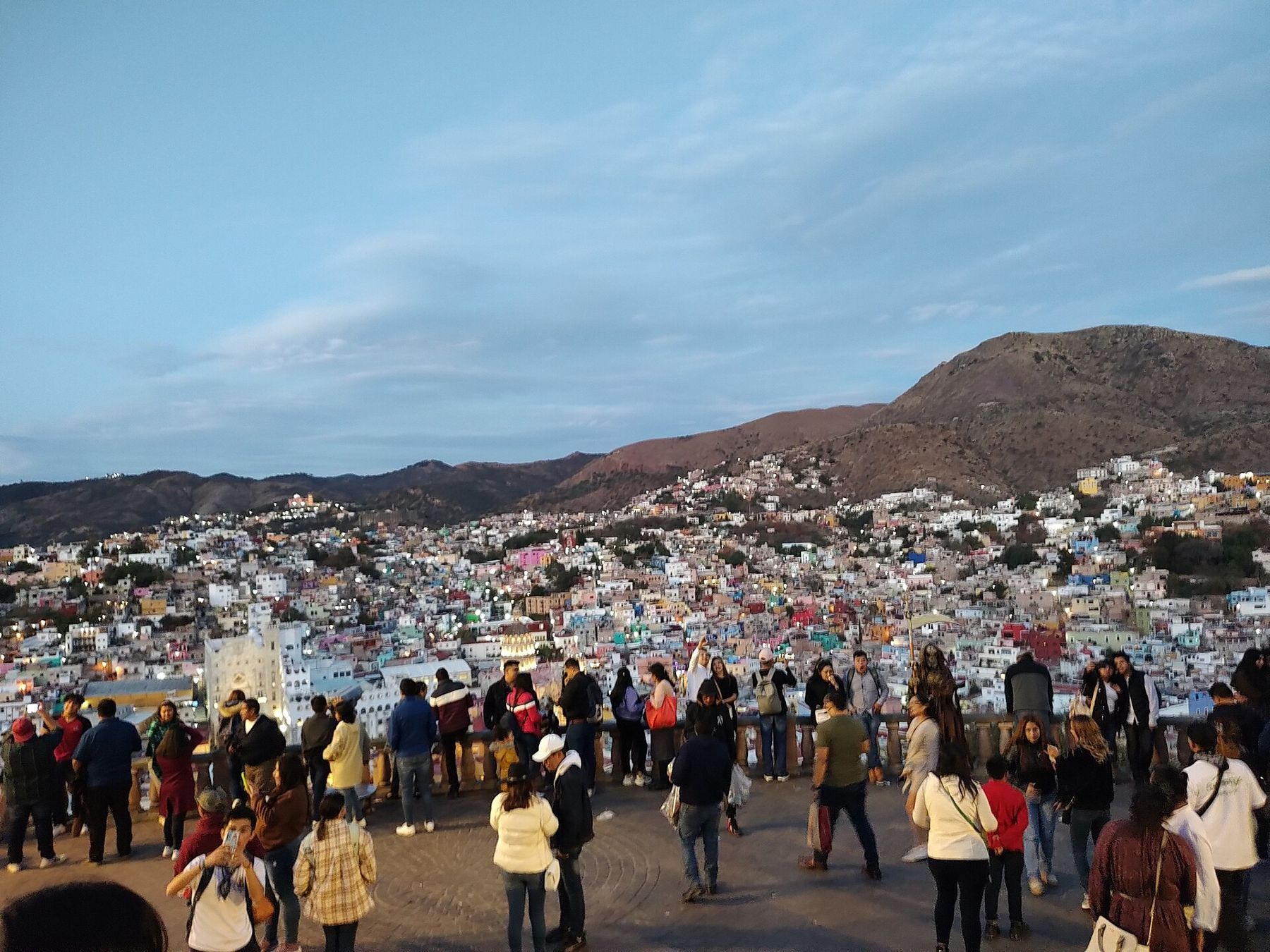
Late afternoon is the favourite time, and for good reason. The low sun warms the painted walls, the shadows give the domes their shape, and as the light fades the houses switch on one by one until the whole ravine glows. That also means the terrace is at its busiest then, with families, couples and street performers sharing the balustrade.
Morning is quieter and often clearer, especially in the dry season from roughly November to May, when the sky over the hills can be a hard, clean blue. In the rainy months, roughly June to September, afternoons may bring cloud and showers, but the hills turn green and the views after a storm can be sharp. At any time of year, bring a layer: once the sun drops, the air at this altitude cools quickly.
A few practical notes
- The terrace and the area around the monument are public and open, but the funicular keeps its own hours. Check them locally before planning a sunset ride down.
- Wear shoes with grip. The stone steps on the walking routes can be worn smooth and slippery after rain.
- Carry water and a hat on sunny days. There is little shade on the climb, and the sun at altitude is strong.
- After dark, keep to the busier, better-lit routes, or take the funicular back down while it is running. As anywhere, keep an eye on your belongings in crowds.
However you get there, give yourself time at the top. Find the basilica, find the university, find the street you walked along that morning. Then go back down into the alleys knowing roughly where they lead, which in Guanajuato is about as much certainty as anyone gets.