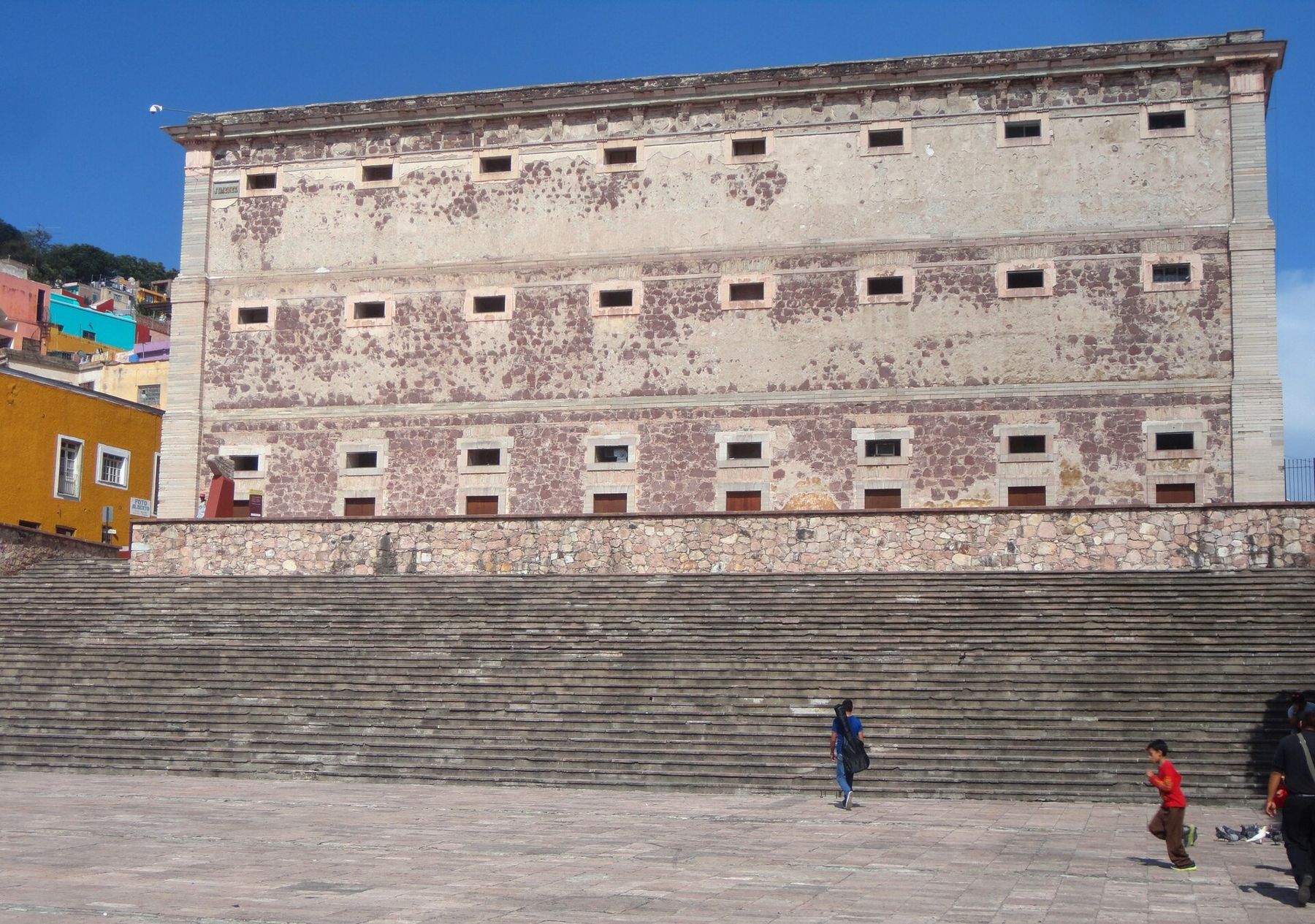
The Alhóndiga de Granaditas does not look like the rest of Guanajuato. Where the town is all colour, curves and balconies, this is a block: a huge, plain rectangle of stone, three storeys high, with rows of small square windows and almost no decoration. It sits above a broad flight of steps a little way from the centre, near the Mercado Hidalgo, and it holds one of the most important stories in Mexican history.
That story is told here plainly. It involves a siege, a great many deaths, and a grim public display that lasted for a decade. It also involves the beginning of a country, and the building today is a museum that tries to hold all of that together.
A granary built like a fortress
An alhóndiga is a public granary, a place where grain and other food were stored and sold. The town needed one: Guanajuato was a large and wealthy mining city in a dry region, and food supply was a constant concern. The Alhóndiga de Granaditas was built at the end of the eighteenth century, under the colonial intendant Juan Antonio de Riaño, and finished in the first years of the nineteenth.
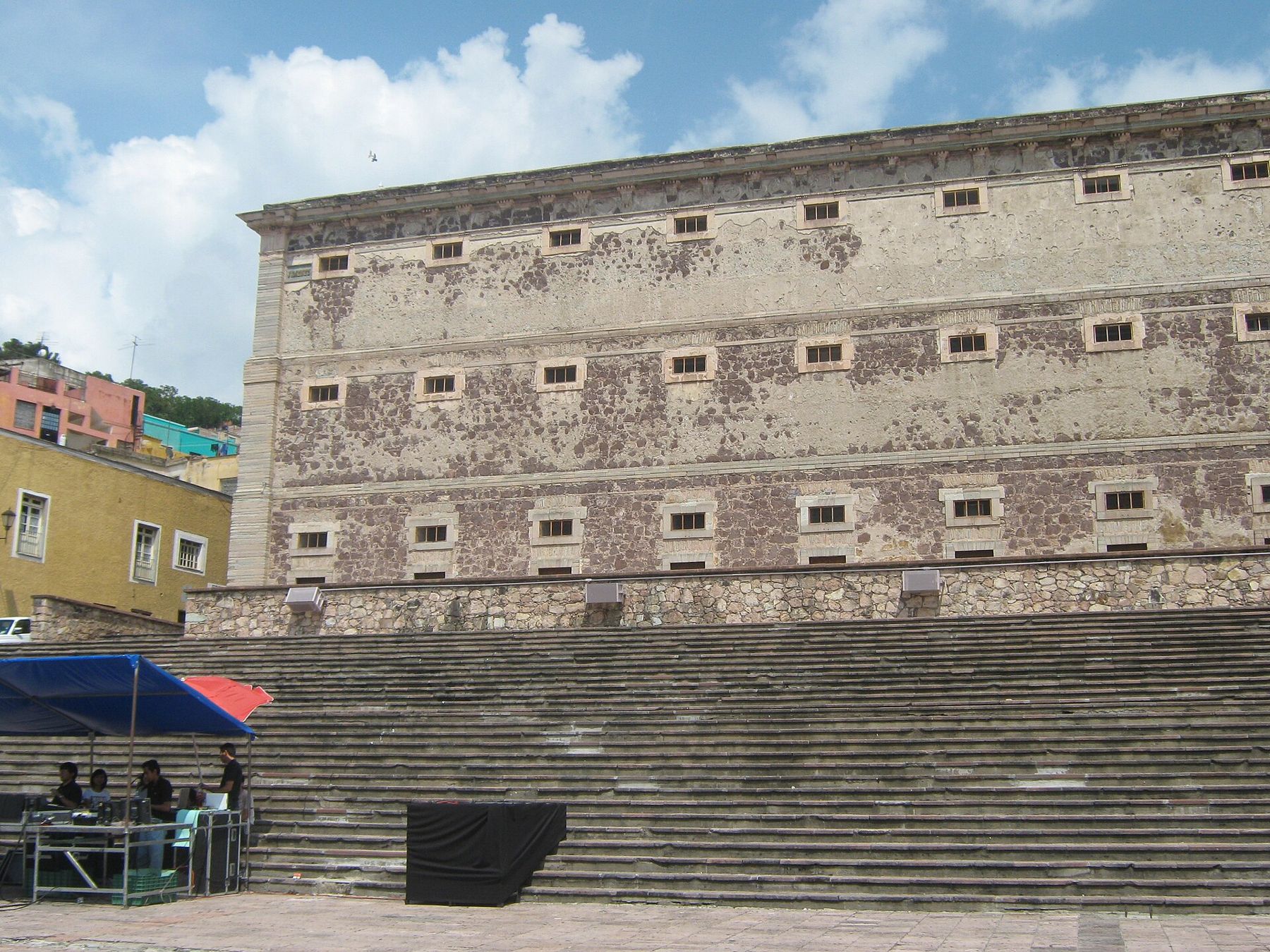
It was built to last. The walls are thick, the windows small and high, and the whole building stands on a raised base above the street. Its style is restrained and neoclassical, with a strong cornice along the top and plain pilasters at the corners. Look at the surface and you can see a patchwork of reddish-brown stones showing through the pale render, giving the walls a mottled, weathered texture.
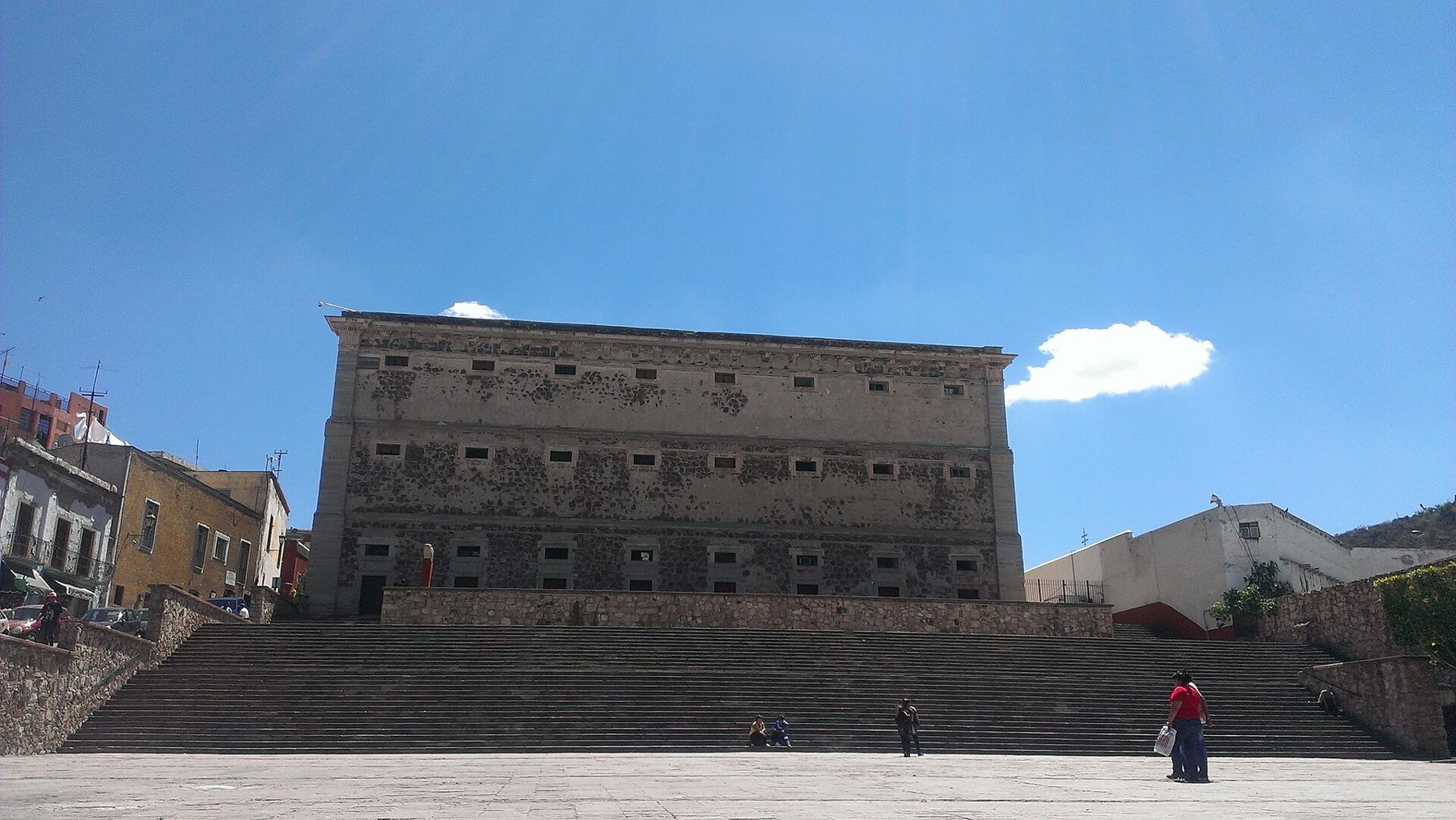
Those qualities made the granary something more than a warehouse. When trouble came, it was the strongest building in town.
28 September 1810
In September 1810, the priest Miguel Hidalgo launched the uprising that would become the Mexican War of Independence. His insurgent army, swollen with country people and workers, marched toward Guanajuato within days. The intendant Riaño gathered Spanish residents, royalist troops and the town's treasure inside the Alhóndiga, and prepared to defend it.
On 28 September 1810, the insurgents attacked. Many of the city's miners joined them. The fighting was fierce, and the defenders fired on the crowd from the windows and roof. Riaño was killed early in the battle. Eventually the insurgents broke through the main door and took the building. Many of those inside were killed, and the city was sacked in the days that followed. It was one of the first major victories of the uprising, and one of its most violent episodes.
It was one of the first major victories of the uprising, and one of its most violent episodes.
El Pípila and the door
Every visitor to Guanajuato meets El Pípila. Tradition tells of a young miner, usually named as Juan José de los Reyes Martínez, who strapped a flat stone slab to his back as a shield against the bullets, crawled up to the Alhóndiga's wooden door, and set it alight with a torch, opening the way for the attack.
Historians have long debated the details. Some doubt that a single figure did all that is told, and the accounts written closest to the events vary. What is certain is that the story became a powerful symbol of ordinary people's courage in the struggle for independence. The giant statue of El Pípila on the hillside above the city, holding a torch aloft, is one of Guanajuato's landmarks, and the climb there is described in up to El Pípila.
The corners, 1811 to 1821
The uprising's early success did not last. Within months the royalist army had recovered, and in 1811 Hidalgo and the other leaders, Ignacio Allende, Juan Aldama and Mariano Jiménez, were captured in the north and executed. Their heads were brought back to Guanajuato and displayed at the four corners of the Alhóndiga, as a warning to anyone who might think of rebelling again.
They stayed there for ten years, through the long years of war that followed, until 1821, when independence was finally won. Then the remains were taken down and later honoured as those of national heroes, and today they rest in Mexico City. Today the building's corners carry the four leaders' names, and many visitors stand quietly at the foot of the walls looking up at them.
The city remembers other famous sons too: the painter Diego Rivera was born here in 1886, and his birthplace is now a museum.It is a difficult history, and there is no need to dwell on more than this. The point that matters is what the building came to mean: a place of defeat and humiliation that became a symbol of the nation's birth.
The museum and the murals
After independence the Alhóndiga served many purposes, including many years as a prison. In the mid-twentieth century it became the Museo Regional de Guanajuato Alhóndiga de Granaditas, and it remains one of the most important museums in the state.
The collections cover the region's history from the pre-Hispanic period through the colonial era, mining and the independence struggle, along with sections on local crafts and traditions. The building itself is part of the exhibit: wide stone corridors, a courtyard surrounded by arcades, and rooms with thick walls and small windows.
The highlight for many visitors is the series of murals by José Chávez Morado in the main stairwell. Painted in the mid-twentieth century, they cover the walls and ceiling with dramatic scenes from Mexican history, including the struggle for independence and the life of the mines. The colours are strong and the figures enormous, filling the space above you as you climb. Take time with them; they reward a slow look from different landings. Notice how the painter uses the shape of the stairwell itself, so that figures seem to lean out over you and the story unfolds as you climb.
Opening hours and admission fees change, and the museum may be closed on certain days of the week, so check before you go.
Around the Alhóndiga
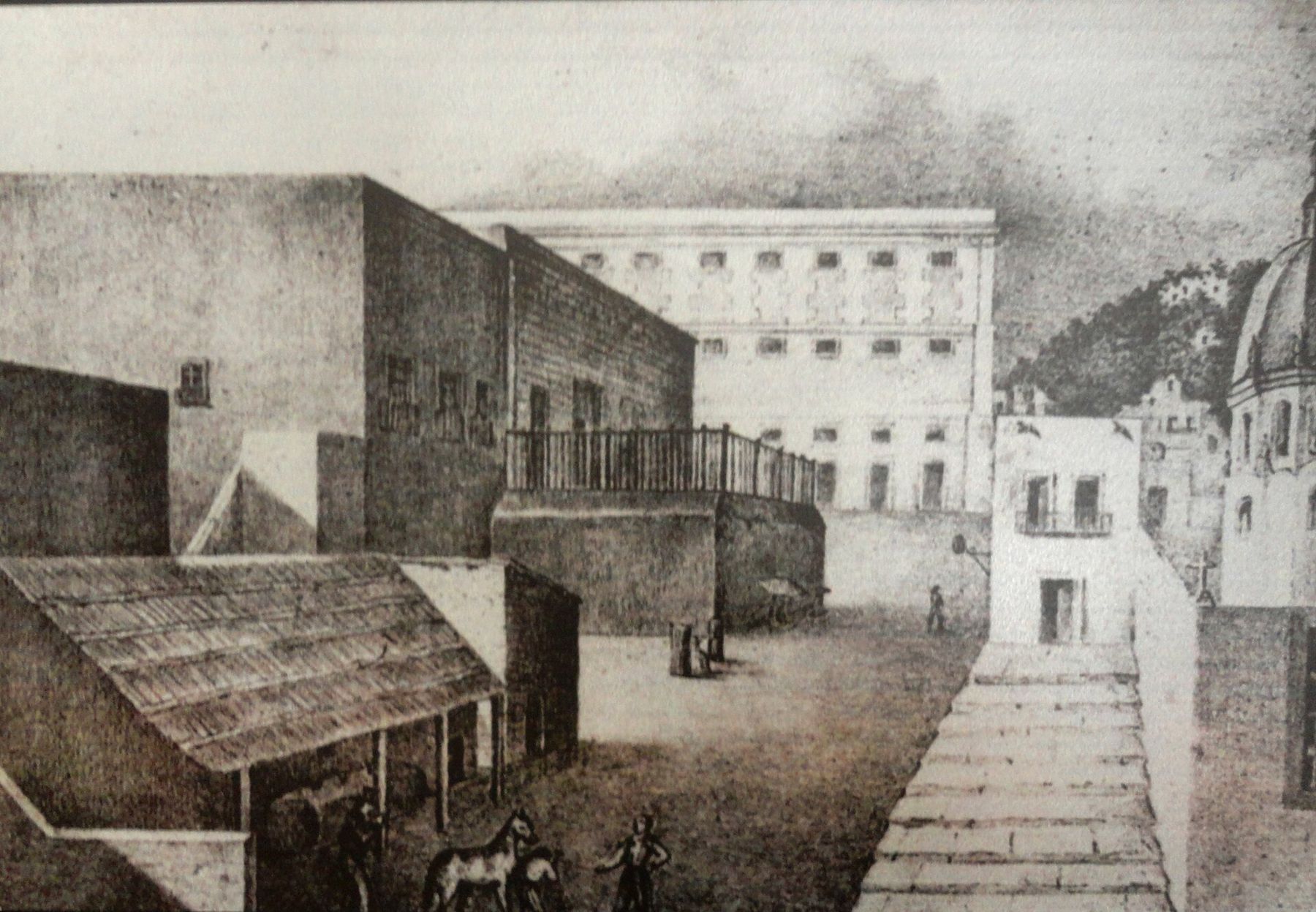
The broad stone steps in front of the building are a public space in their own right. People sit there in the sun, children run across the plaza at their foot, and during festivals the steps sometimes become seating for performances. A nineteenth-century engraving shows the Alhóndiga rising behind lower houses on a street that climbs up to it, much as it still does today.
The building stands close to the lower end of the old town. A short walk downhill brings you to the iron-roofed Mercado Hidalgo, and from there the main street leads back toward the plazas and the Jardín de la Unión. If you are interested in where the region's wealth came from, the mines at La Valenciana complete the picture.